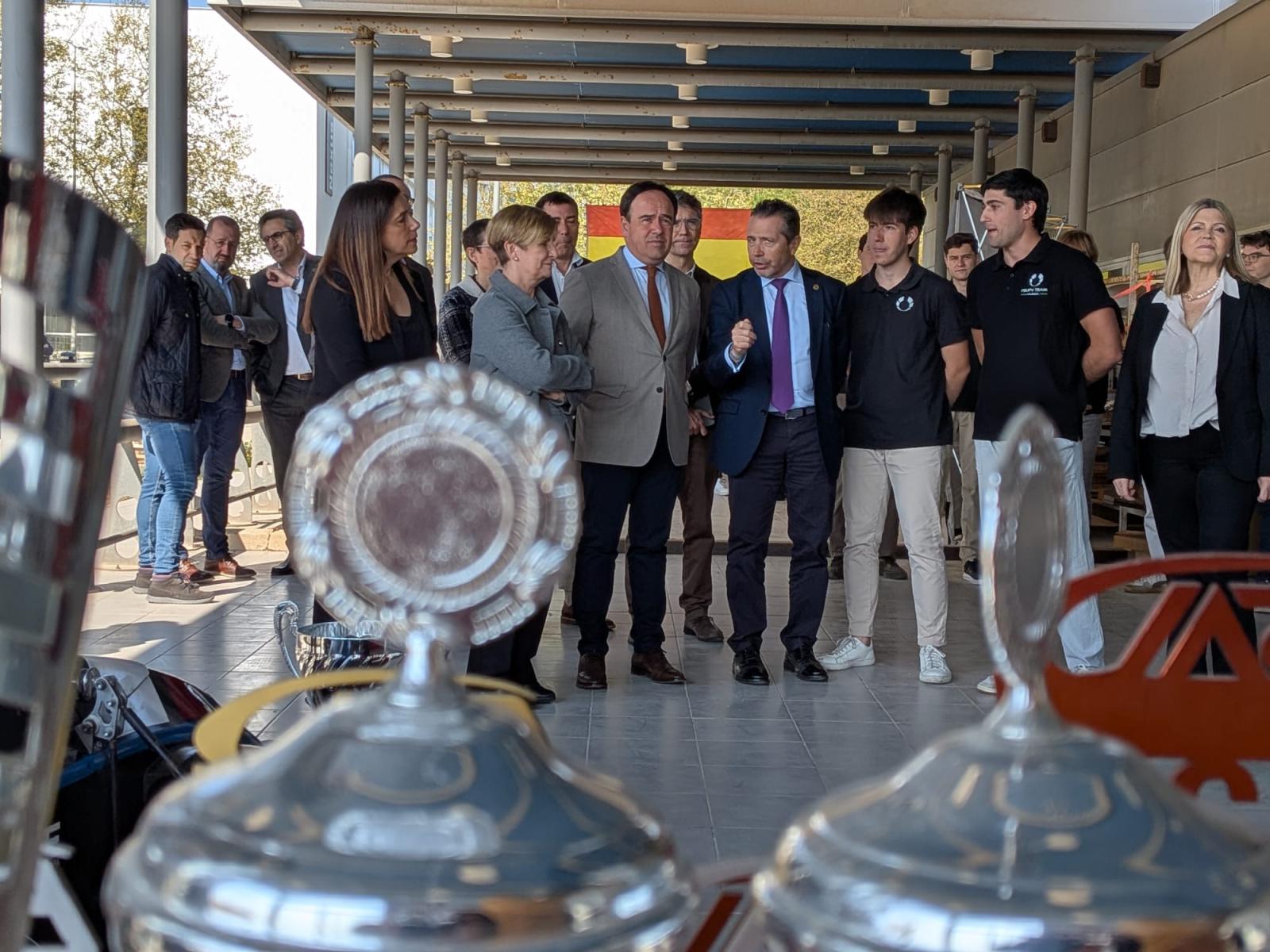
During the visit, the Rector of UPV, José Capilla, highlighted the strategic role of this programme in student education. “Generación Espontánea is key to training. It brings together a set of activities that provide a differential value that cannot be replaced by artificial intelligence,” he stated.
Capilla emphasised the diversity and scope of the programme, which brings together more than 60 teams with very different profiles. “Here, all kinds of problems are solved, and from this programme the best engineers can emerge,” he said. In this regard, he highlighted the achievements of the teams: “Students give us enormous satisfaction. I have witnessed their victories and, with far fewer resources, they have managed to outperform teams with up to ten times more budget.”
The Rector also underlined the multidisciplinary and collaborative nature of Generación Espontánea. “It is an example of public-private collaboration. Companies have their own interests, but they help us train talent. In addition, students from business, fine arts, engineering or marketing take part and organise themselves efficiently. These are learnings that are often more fundamental than classroom theorems,” he explained.
In this line, he stressed that the programme allows students to develop key competences beyond the academic field. “Here they learn to manage stress, emotions, fundraising, teamwork, leadership, as well as failure and success. It is at the level of the best international programmes and stands out especially for its strong connection with companies,” he noted, while thanking the support of the Generalitat Valenciana and expressing his wish that “this model be extended to other public universities.”
Capilla also reflected on the current context shaped by the rapid advancement of artificial intelligence. “AI is replacing intellectual work, which forces us to rethink what and how we teach. Companies are looking for different skills, and programmes like this respond to that need,” he said. He also recalled the organisational complexity of the initiative: “It is not easy to manage a programme like this within a university. It is unique in Spain,” he concluded.
During the visit, the President had the opportunity to meet some of the programme’s most representative teams, such as Hyperloop UPV, Faraday Rocketry UPV, FSUPV Team and Talpa Tunneling UPV, which place UPV among the global elite in areas such as mobility, rocketry and applied engineering.
For his part, the President of the Generalitat Valenciana, Juan Francisco Pérez Llorca, praised the initiative and the talent of the students. “It is an honour to come and discover what you are capable of doing. Generación Espontánea is a pleasant surprise, a programme that needs to be seen and experienced to be understood,” he said.
He also highlighted the importance of institutional collaboration. “The future of universities looks very much like what Generación Espontánea represents. Here you learn what life is about. From the administration, what we must do is collaborate and move forward together with universities,” he concluded.