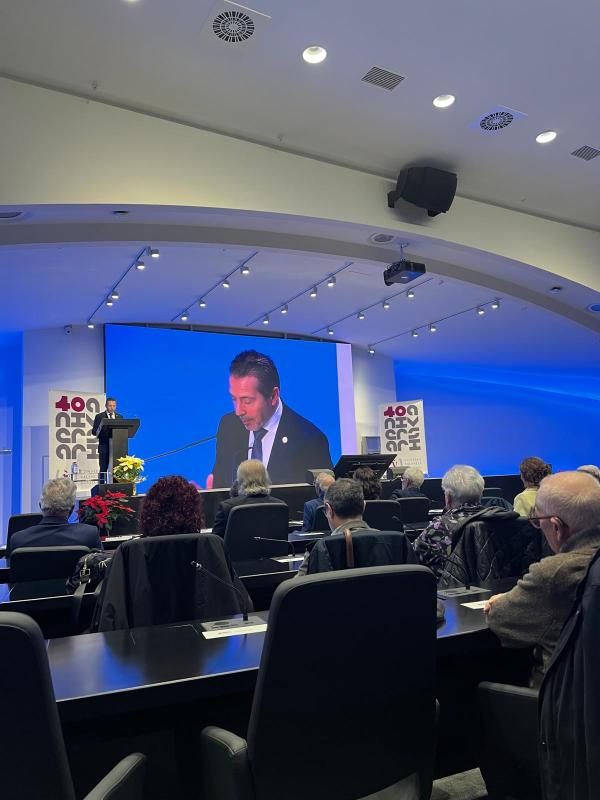
In his address, Capilla has underlined that “forty years are not a mere chronological passage”, but a period long enough for “the world around us and what society demands from us to have undergone profound transformations”. In this regard, he has affirmed that reaching this stage should mean “maturity of judgement, solidity of criteria and clarity of principles”, recalling Confucius’ well-known reflection: “At forty, I had no more doubts”.
The Rector has highlighted that the Valencian Council of Culture reaches this anniversary “with great maturity: with a consolidated track record, with a recognised voice”, and does so “with the serenity required to contribute rigorously to the cultural dialogue of Valencian society”. He has also emphasised the Council’s plural essence since its origins, conceived as a space that does not seek to impose a single vision of Valencian culture, since it “does not belong to any specific institution, but to all Valencian men and women”.
Capilla has recalled that the Council was born in a context of intense identity tension following the democratic transition and that, over its forty years of history, it has offered “multiple examples of dialogue, of the ability to build bridges and of the will to reach agreements” in an area as sensitive and fundamental as culture. In this sense, he has stated that its role should continue to be that of a “bridge between different social sensitivities”, drawing on values which, as he recalled quoting Vicente Blasco Ibáñez, are based on the idea that “civilisation is respect for others and tolerance towards differing opinions”.
During his speech, the Rector has evoked some of the most prominent figures who have been members of the Valencian Council of Culture and has made special mention of Professor Justo Nieto, a member of the Council in the 1990s, highlighting that he transformed “a young university, created at the dawn of the democratic transition, into an international benchmark in science, technology, art and culture”, in a trajectory with clear parallels to that of the Council itself.
The link between UPV and the Valencian Council of Culture has also been present in the address, particularly through the figure of its current President, UPV Professor José María Lozano, as an example of the synergies between two institutions that “were born in the same period and in a similar historical context, with a clear vocation for public service and for contributing to the cultural and social development of our territory”.
Capilla has highlighted UPV’s constant contribution to the conservation and promotion of Valencian heritage and has recalled that, beyond its traditional association with engineering or science, cultural creation is an essential part of the university. In this regard, he has evoked the words of Santiago Grisolía in stating that “science is culture and, as such, an instrument of understanding between peoples”.
The Rector has concluded his address by underlining that, in institutions such as UPV and the Valencian Council of Culture, “more than a merely contemplative view of the past, there must be a clear vocation towards the future, towards creation and towards continuing to generate Valencian culture”, before congratulating the Council on its forty-year trajectory and wishing it “many more years to come, full of success and of enrichment of Valencian culture”.